History
Intent
The aim of History is to explore and think critically about the facts and opinions of people and events to gain a sound understanding of how historical events and significant figures have shaped the modern world and the importance and impact Britain has played throughout these changes in time.
In line with the 2014 National Curriculum: History Programme of Study, we aim to ensure that all pupils:
- Know and understand the history of these islands as a coherent, chronological narrative, from the earliest times to the present day: how people’s lives have shaped this nation and how Britain has influenced and been influenced by the wider world.
- Know and understand significant aspects of the history of the wider world: the nature of ancient civilisations; the expansion and dissolution of empires; characteristic features of past non-European societies; achievements and follies of mankind.
- Gain and deploy a historically grounded understanding of abstract terms such as ‘empire’, ‘civilisation’ and ‘parliament’.
- Understand historical concepts such as continuity and change, cause and consequence, similarity, difference and significance, and use them to make connections, draw contrasts, analyse trends, frame historically-valid questions and create their own structured accounts.
- Understand the methods of historical enquiry, including how evidence is used rigorously to make historical claims, and discern how and why contrasting arguments and interpretations of the past have been constructed.
- Gain historical perspective by placing their growing knowledge into different contexts, understanding the connections between local, regional, national and international history; between cultural, economic, military, political, religious and social history; and between short- and long-term timescales.
We are committed to providing our children with an exciting and positive learning environment, where they develop knowledge of themselves as well as Britain and the wider world.
Benin Drama Workshop
As part of their ‘Maafa’ History topic, the children participated in a Benin workshop. They explored the Kingdom of Benin through stories and activities, learning how it grew, expanded, and declined. This helped establish a clear historical narrative and understanding of a non-European society in contrast to British history.


Local History Study


Miner's stained glass window - St John's Church
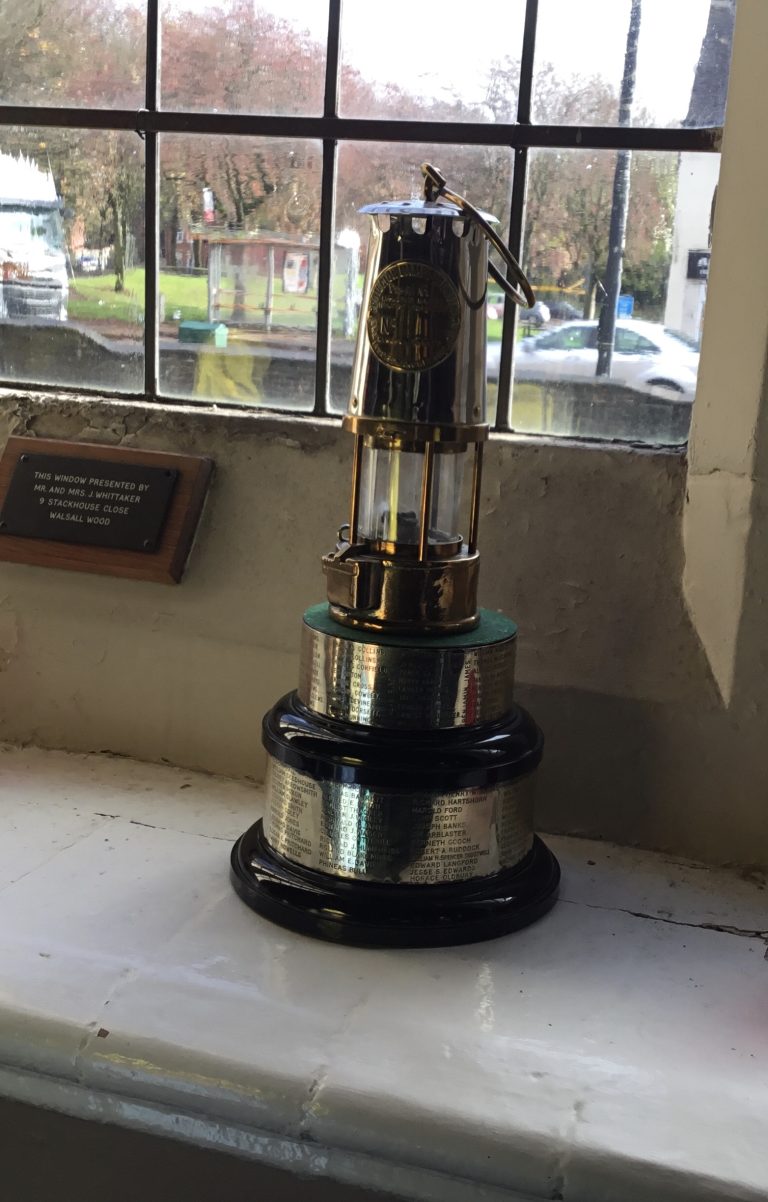
Miner's Lamp in St John's Church
The children developed a chronologically secure understanding of history, focusing on Walsall Wood as a thriving mining community. They visited memorials, monuments, and St John’s Church to learn how mining shaped the local area (1874-1964).
National Memorial Arboretum


Year 5 and 6 visited the National Memorial Arboretum to enhance their knowledge of Britain at War, asking historically valid questions and analysing change, cause, and significance. The trip provided a meaningful connection to their studies of WWI and WWII.
Implementation
Our teaching enables children to think like historians. Through artefacts and sources, children extend their knowledge of Britain’s past and the wider world. Cross-curricular Cornerstones topics help children understand how history has shaped culture, beliefs, and daily life.
By the end of primary school, children have a chronological understanding of British history from the Stone Age to present day. Pupils learn to know, apply, and understand the skills and processes specified in the National Curriculum.
Early Years
Pupils reflect on changes to themselves and their family, developing a sense of past and present. They examine artefacts and use vocabulary like ‘yesterday’, ‘today’, and ‘last week’ to describe events such as birthdays and Christmas.
Key Stage 1
Pupils develop awareness of the past using common words and phrases. They place events and people in chronological order and identify similarities and differences across periods. Pupils:
- Study changes within living memory to reveal aspects of national life.
- Explore events beyond living memory significant nationally or globally (e.g., Great Fire of London, first aeroplane flight).
- Learn about significant individuals in the past who contributed to national and international achievements (e.g., Neil Armstrong, Rosa Parks, Florence Nightingale).
- Study significant historical events, people, and places in Walsall and the West Midlands.
Key Stage 2
Pupils continue to develop chronological understanding of British, local, and world history, noting connections, contrasts, and trends. Pupils:
- Study Britain from Stone Age to Iron Age
- Explore the Roman Empire and its impact on Britain
- Learn about Anglo-Saxon settlement and Viking struggles
- Undertake a local history study
- Study an aspect or theme in British history beyond 1066 (e.g., Battle of Britain)
- Explore achievements of earliest civilizations (Ancient Egypt)
- Study Roman life and influence
- Study a non-European society contrasting with British history (Benin c. AD 900)
Our curriculum ensures children can ask perceptive questions, think critically, and experience historical sites and visitor workshops.
Impact
Children understand the complexities of people’s lives and the diversity of societies over time. Through Cornerstones and school values, children reflect on identity and the impact of significant historical figures on the modern world.