PSHE/RSHE
Intent
At St John’s, we believe that every child is unique and valued by God. All we do is underpinned by our Christian values which are linked to the fruits of the spirit. We are a supportive community which seeks to nurture each individual child as they grow. Every member of our school community is encouraged to respect and value each other. Wherever possible we make close links between our values, worship, PSHE and RSHE curriculum.
PSHE (Personal, Social, Health and Economic) and RSHE (Relationship, Sex and Health Education) education are an important and necessary part of all pupils’ education. Through a planned programme of learning, we aim to provide our pupils with the knowledge, understanding and skills that they need in order to manage their lives both now and in the future. As part of a whole school approach, we aim to develop the attributes our pupils need to thrive as individuals, as part of a family and as a confident member of the wider community.
Our school is committed to serving its community and surrounding areas. We recognise the multicultural and multi-faith nature of the United Kingdom, and those we serve. We also understand the vital role we have in ensuring that groups or individuals within the school are not subjected to intimidation or radicalisation by those wishing to unduly, or illegally, influence them.
At St John’s, we embrace the British Values of: Democracy, The rule of law, Individual liberty, Mutual respect and Tolerance of those of different faiths and beliefs. We want our children to learn to understand and respect our common humanity, diversity and differences so that they can go on to form the effective, fulfilling relationships that are an essential part of life and learning.
We undertake to follow the principles in the Church of England Charter for faith sensitive and inclusive relationships education, relationships and sex education (RSE) and health education (RSHE).
We follow the Equalities Act 2010 www.legislation.gov.uk/ukpga/2010/15/contents
Implementation
We are members of the PSHE Association and use this and 1Decision to plan and deliver our PSHE and RSHE curriculum to KS1 and KS2. https://pshe-association.org.uk/
1Decision uses interactive resources which encourage children to consider a range of real life scenarios. The resources focus on how children respond to and manage different influences and pressures. www.1decision.co.uk/
Through the PSHE Association and 1Decision, we cover all of the statutory content from the DfE statutory guidance on PSHE and RShE. This coverage is assured by a mapping document.
To make our curriculum bespoke and meet the needs of our pupils, we use additional programmes. These are:
Votes for Schools
Votes for schools provides weekly resources to prompt discussion on current issues. This supports the PSHE curriculum and covers Prevent, British Values and the SMSC Curriculum. Pupils vote and comment on a discussion topic. National results are collated on the Votes for Schools website. The three principles of Votes for Schools are:
- Be informed
- Be curious
- Be heard
https://www.votesforschools.com/
Zones of Regulation
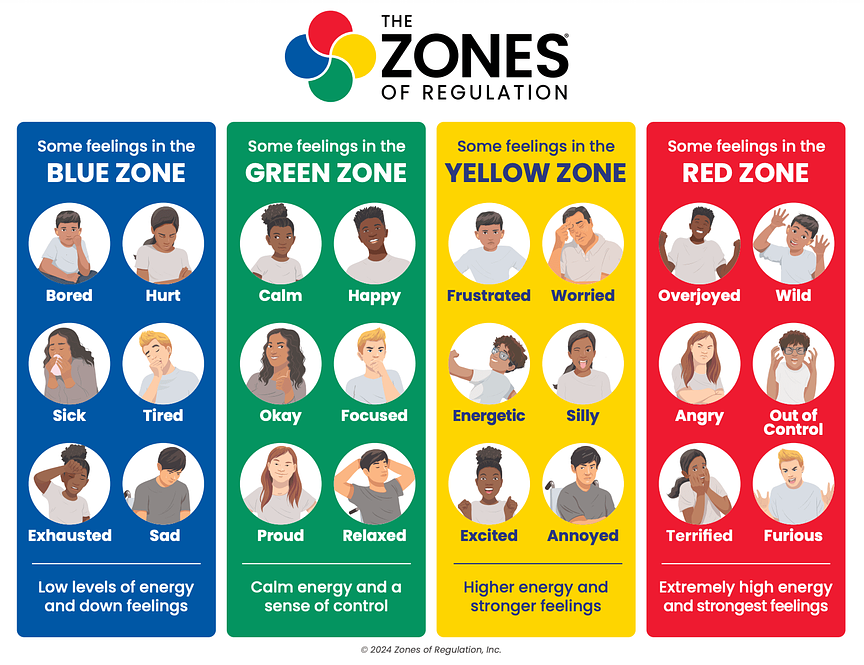
We also use Zones of Regulation to further support children’s emotional development and self-regulation skills. This is a self-regulation curriculum that helps learners recognise, understand and manage their emotions, behaviour and sensory needs.
Zones of Regulation is built into our PSHE planning on a termly basis and is consistently taught from Early Years right through to Key Stage 2, ensuring a shared language and approach across the whole school. It supports pupils to:
-
Identify their feelings and emotional states
-
Develop strategies to manage strong emotions
-
Build resilience and problem-solving skills
-
Improve focus, wellbeing and positive relationships
By embedding Zones of Regulation, we help children develop lifelong self-regulation skills that support learning, behaviour and mental wellbeing across school and beyond.
https://zonesofregulation.com/
NSPCC Speak Out Stay Safe KS2
This is a safeguarding programme which helps children understand:
- abuse in all its forms and how to recognise signs of abuse
- that abuse is never a child’s fault and that they have the right to be safe
- where to get help and the sources of help available to them, including our childline.
NSPCC PANTS and Pantasaurus KS1 and LKS2
The age appropriate resources which include the friendly pantasaurus dinosaur help children to understand that their body belongs to them and they should tell someone that they trust if anything makes them upset or worried.
Impact
We want our children to develop self-awareness, positive self-esteem and confidence, enabling them to:
- Have a sense of purpose
- Value self and others
- Form healthy and positive relationships
- Make and act on informed decisions
- Communicate their thoughts and feelings effectively
- Work with others
- Respond to challenge
- Be an active partner in their own learning
- Be active citizens within the local community
- Explore issues related to living in a democratic society
- Develop healthy lifestyle and positive wellbeing habbits
- Grow into confident, healthy and fulfilled individuals
In a 2025 pupil survey, all pupils agreed or strongly agreed that they enjoy their PSHE lessons and learn a lot.
Pupils told us that activities within their PSHE lessons were interesting and they felt comfortable sharing their views.
“PSHE can be relatable and it teaches us the right path for a bright future.” Y5 pupil.
“The best thing about PSHE is how there can be different ways of answering a problem.”
“I likes the videos and I like the decisions.”
“I like choosing A or B in 1Decesion and I think I learn a lot in PSHE.”
In a staff survey at the same time, staff agreed or strongly agreed that they had a good understanding of how we teach PSHE and RSHE. They felt confident to deliver all aspects of the PSHE and RSHE programmes.
Staff recognised the importance of encouraging pupils to share their views and opinions and felt able to manage these discussions effectively.
PSHE in the Early Years:
PSHE sits within the areas of personal, social and emotional development and understanding of the world. In Early Years, our children learn to develop respectful communication and they are aware of the feelings and wishes of others.
IN EYFS, our curriculum and PSHE programme ‘SMILE’ helps children to build their confidence, resilience and self-esteem and to identify and manage risk. They develop the skills to make informed choices and understand what influences their decisions. It enables children to respect themselves, others and to celebrate diversity whilst managing their emotions and communicating effectively. Developing and understanding of themselves, empathy and the ability to collaborate with others helps children to form and maintain good relationships and better enjoy and manage their lives.
Relationships, Sex and Health Education (RSHE)
Relationships, Sex and Health Education (RSHE) is taught alongside Personal, Social, Health and Economic Education (PSHE). RSHE focuses on helping children build healthy relationships, understand their changing bodies, develop positive wellbeing, and learn how to keep themselves safe.
RSHE is woven throughout all of our PSHE topics to ensure a consistent and holistic approach. In addition, from Year 1 to Year 6, specific RSHE objectives are taught explicitly when they naturally align with the PSHE themes being covered, ensuring age-appropriate and progressive learning.
We use PSHE Association and 1Decision to support our planning and delivery of RSHE, ensuring that all statutory requirements are fully covered.
1decision RSHE for parents and carers
RSHE includes a wide range of topics :
- Families and people who care for me
- Caring friendships
- Respectful, kind relationships
- Online Safety awareness
- Being Safe
- General wellbeing
- Online Safety
- Physical health and fitness
- Healthy eating
- Drugs, alcohol, tobacco and vaping
- Health protection and prevention
- Personal safety
- Basic first aid
- Developing bodies
Learning begins in Year 1 and continues through to Year 6. Topics are carefully sequenced to be age appropriate and are revisited in increasing depth as children grow older.
From September 2020, Relationships Education and Health Education became statutory in all primary schools, as set out by the Department for Education. This means that all schools must teach these subjects as part of the curriculum, just like English and maths.
Teaching about Growing and Changing
Puberty can begin as early as age 8. Our curriculum is designed to ensure children are aware of the physical and emotional changes that take place during puberty.
We begin gently introducing this learning in Year 4, with content building in Years 5 and 6. This keeps conversations open and supports children who develop at different rates or have questions at different times.
Parents and carers are informed in advance of teaching about Growing and Changing and are welcome to come into school to view and discuss the resources we use. All content and materials are carefully selected by staff and governors. Parents and carers have the right to withdraw their child from these lessons.
To support discussions at home, we share a video from the Walsall School Nursing Service and recommend the Usborne book What’s Happening to Me? for parents and carers to read themselves and share with their child when appropriate.
Year 4
-
Towards the end of the school year, pupils watch Operation Ouch! – Don’t Panic About Puberty Special.
We encourage parents and carers to watch this programme at home. It covers body changes, sleep, emotions, spots, testicles and periods.
Operation Ouch, Don't Panic About Puberty
Year 5
-
Pupils receive more detailed teaching about periods using resources from Betty Education.
-
Puberty is taught using the Help I’m Hairy resources.
Year 6
-
Pupils learn about puberty through the 1Decision Puberty lesson.
Teaching About Conception
In Year 6, pupils are taught about human conception using familiar 1Decision resources. This learning includes:
-
The terms conception and reproduction
-
The functions of the male and female reproductive systems
-
Different ways adults can have a child
-
Stages of pregnancy
-
Laws around consent
Parents and carers are informed in advance and offered opportunities to view and discuss resources. Parents and carers have the right to withdraw their child from this content.
Statutory teaching about growth, development and reproduction in plants, animals and humans is also covered within the science curriculum.